
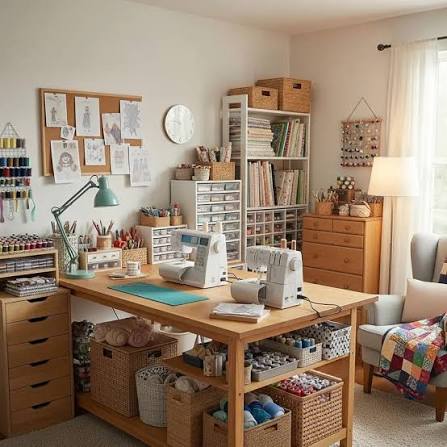
Setting Up a Home Sewing Studio: What Delight Graduates Need to Get Started
By Delight Technical College | School of Tailoring, Fashion & Design | 2026
For many Delight Technical College fashion graduates, particularly in the early stages of their professional careers, the most practical and financially accessible starting point is a home-based sewing studio, a dedicated working space within their home that is equipped, organised, and professional enough to support quality production and, where appropriate, client visits. Here is a practical guide to setting up a functional home sewing studio on a realistic budget.
📐 Space Planning and Ergonomics
Dedicated Space:
Even a small, dedicated area like a spare room, a partitioned corner of a larger room, or a garage or outbuilding is significantly more effective for productive work than attempting to use shared family living space, which creates constant setup and packaway overhead and makes it difficult to maintain work in progress.
Ergonomic Sewing Setup:
- Sewing table at correct height- the sewing machine bed should typically be at elbow height when seated, to prevent shoulder and neck strain during extended working periods
- Good direct lighting over the machine and cutting area- both general room lighting and a directed task light on the machine
- An ergonomic chair that provides back support during long sewing sessions
- Storage within reach- thread, scissors, and frequently used tools easily accessible without constant movement
🧵 Essential Equipment for a Home Studio
Core Machinery:
- Industrial or semi-industrial sewing machine- significantly faster and more capable than domestic machines for production-quality work
- Overlocker/serger- for professional-finish seam edges that are impossible to replicate with a standard machine
- Steam iron and ironing board- pressing is a critical part of professional garment production, not a finishing afterthought
Hand Tools:
- Quality fabric scissors- dedicated to fabric only, never used on paper or other materials that dull the blade
- Seam ripper, tailor’s chalk, pins and pin cushion, tape measure, and needles- the standard toolkit already provided in the Delight Starter Pack
- Dress form- adjustable to body measurements for fitting and form-shaping work
Cutting and Pattern Area:
- Cutting table at standing height- prevents the back strain of cutting fabric on the floor, a common amateur practice that professional production cannot sustain
- Pattern storage- a flat, organised system for storing and retrieving patterns without damage
🏠 Making a Home Studio Client-Ready
If clients will visit for fittings or consultations:
- A clean, presentable changing area with adequate privacy
- A full-length mirror for fitting review
- Separation of work clutter from client-facing areas- the sewing table and production area do not need to be spotless, but the client experience area should be clean and professional
🎓 Building on Delight’s Foundation
Delight’s workshop environment, with professional machines, organised workspaces, and proper ergonomic setup, models the professional sewing environment that home studios should aspire to. Students who observe and internalise these professional workspace standards during their training are better equipped to recreate appropriate professional conditions in their home studios.
“The home sewing studio is where most Delight fashion graduates begin their professional journey and it can be an entirely professional, productive, and client-appropriate working environment when set up thoughtfully. At Delight, we help graduates start right.”
📍 Delight Technical College | Muindi Mbingu Street, Opposite Jevanjee Gardens, Nairobi | +254 722 533 771 | www.delight.ac.ke