
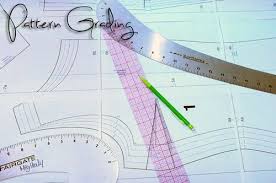
Pattern Grading Explained: Scaling Fashion Designs Across Size Ranges at Delight
By Delight Technical College | School of Tailoring, Fashion & Design | 2026
One of the most technically challenging and commercially essential skills in professional fashion production is pattern grading which is the the systematic scaling of a garment pattern from one size to a full range of sizes. It sounds straightforward: make the pattern bigger or smaller. In practice, it is one of the most nuanced and technically demanding skills in fashion and at Delight Technical College, it is given the dedicated attention it deserves in the 160-hour Pattern Construction and Grading module at Level 5.
📐 What Is Pattern Grading?
Pattern grading is the process of proportionally increasing or decreasing a base pattern to create a full size range while maintaining the design integrity, fit characteristics, and visual proportions of the original. When a fashion designer creates a collection, they typically produce a base pattern in a single size. Before the collection can be manufactured or sold commercially, that base pattern must be graded to the full range of sizes the label will offer.
🔢 Why Grading Is Not Simply ‘Making It Bigger’
The complexity of grading comes from the fact that the human body does not scale uniformly. When a body increases in size, different measurements increase at different rates:
- The bust measurement may increase by 4cm between sizes
- The waist may increase by 4cm between sizes
- The hip may increase by 4cm between sizes
- But the shoulder width increases at a different rate
- And the sleeve length increases at a different rate still
- And the proportional relationships between body parts change as size increases
A garment that is simply scaled up uniformly from a size 8 pattern will not fit a size 16 body correctly because the body is not simply a larger version of the same shape. Professional grading accounts for these differential growth rates by applying different increments to different parts of the pattern.
📏 Grading Methods
Cut-and-Spread Grading:
The traditional method, the pattern is cut at specific points and spread apart (or overlapped) by the required increment to create the next size. Each new size requires a separate cut-and-spread operation.
Shift Grading:
The more common professional method, the pattern pieces are shifted along two axes (vertical and horizontal) by calculated increments at key reference points. This method is faster and more systematic than cut-and-spread.
Digital Grading:
Using CAD software (Computer-Aided Design, taught at Level 6 at Delight) to grade patterns mathematically and instantly across a full size range. The most efficient method for production grading and the standard in modern industrial fashion production.
🎓 Pattern Construction and Grading at Delight- Level 5
- Module: Pattern Construction and Grading | Level: 5 | Term: Four
- Total Hours: 160 | Hours per Week: 15
What You Will Learn:
- Body measurement and size chart development- the foundation of accurate grading
- Grading increments for different garment types and size systems
- Applying grading to bodice patterns- front, back, and side seams
- Grading sleeve patterns- maintaining correct proportional relationships
- Grading trouser patterns- the most technically complex grading operation
- Creating a complete graded pattern set from a single base pattern
- Verification- checking graded patterns for accuracy before cutting
💼 Why Grading Skills Are Commercially Valuable
- Every fashion label that produces a size range needs grading expertise
- Garment factories need production pattern graders- a specialist role with premium pay
- Designers who can grade their own patterns save significant outsourcing costs
- Graduates who offer grading services to other designers can build a specialist service business
“A designer who can only produce one size has a creative practice. A designer who can grade is ready for production. Pattern grading is where fashion creativity meets commercial reality and at Delight, we teach it with the depth it deserves.”
📍 Delight Technical College | Muindi Mbingu Street, Opposite Jevanjee Gardens, Nairobi | +254 722 533 771 | www.delight.ac.ke